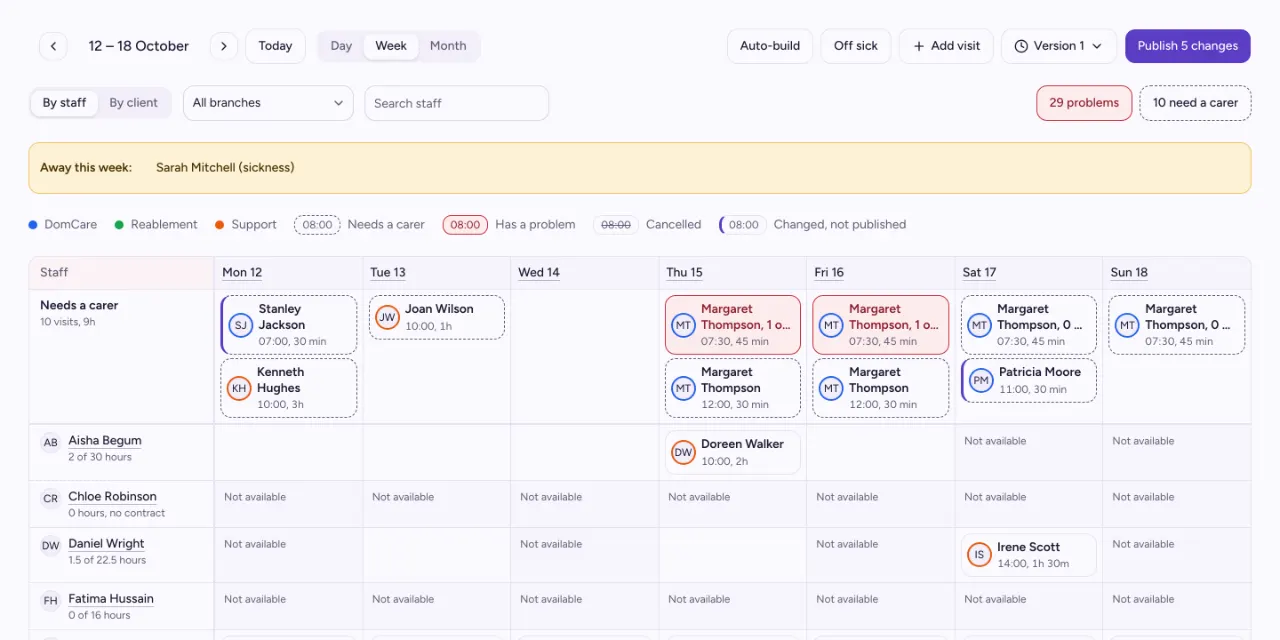
1. Start from each client's visits
A home care rota exists to get the right care to each client at the right time, so start there. List every client's regular visits for the week: the time, how long it lasts, and whether it needs one carer or two. Some visits, like medication rounds or meal times, can't move much. Others have more give. Note which is which.
Keeping these visit schedules as a standing pattern means each new week starts from what clients need, not from last week's rota with its one-off changes.
2. Know when each carer can work
Next, collect when each carer is available and how many hours their contract gives them. A carer on a 30-hour contract who is free every weekday morning is a different resource from one who only works weekends.
Booking someone outside their available time is the quickest way to a missed visit, so treat availability as a hard rule, not a preference.
3. Match carers to visits
Fill the visits that are hardest to staff first: double-up visits that need two carers, early mornings, late evenings and weekends. Then fill the rest.
Where you can, give each client carers they already know. Continuity of care matters to clients, and it makes each visit quicker because the carer knows the routine.
4. Leave real travel time
A rota that looks full on paper can fall apart on the road. Check the drive between each pair of visits and make sure the gap allows for it, plus a few minutes for parking and getting in.
Travel time also matters for pay. Time spent travelling between visits generally counts as working time for National Minimum Wage purposes, so it is worth knowing how much your rota asks of each carer.
5. Check for problems before you share it
Before the week goes out, look for clashes: two visits for the same carer at once, a carer booked while on holiday, someone pushed over their contracted hours, a double-up with only one carer. Fixing these on Thursday is much easier than on Monday morning.
6. Publish, then track changes
Share the rota with carers once it is finished, not while you are still moving things around. After that, changes will happen: sickness, hospital admissions, new clients. Record each change so you can see who was told what, and keep an eye on visits that keep going unfilled week after week.
Questions
How far ahead should a home care rota be planned?
Most agencies plan a week or two ahead, with regular visits repeating each week and changes made as they come up.
What should a home care rota include?
Each visit's client, time, length, number of carers and the carers booked, plus the travel between visits.
See Isabelle with your own rota.
We'll walk you through it.